The Rising Star property is actually within jurisdiction of Thotanaval village, a very small hamlet running along both sides of the road that goes by the campus. The village has maybe two hundred people, most of whom work in the fields and live in very humble circumstances. About forty children from the village attend our school as "day scholars," meaning they do not live in our hostels with the colony children.
Vickie and I walked the quarter mile or so to the village one afternoon just to get some exercise and greet the local folks. The first interesting sight was this little girl and one of her family's prized possessions. Cows have free range all over India and often represent most of a family's wealth.

Many of the people live in very basic dwellings consisting of poles in the ground, a basic framework of bamboo for rafters, and thatch of leaves. These leaves are from the Palmyra palm, which bears a fruit shaped not unlike a small coconut. The fruit inside looks and tastes like a fist-sized litchee. The Tamil people call it "nung gu."

Like any town, the gentry live in nicer homes. This family compound has a much larger house, a smaller place for the animals, and a wall made of the same nung gu leaves.

As families can afford it they build more permanent homes out of brick. This is not American-style brick veneer on a frame house, but rather a two-deep wall of bricks mortared together and covered with plaster. The bricks are all made locally, so you can see the color of our clay. Wooden scaffolding, of course; what else would you expect in Asia? I'm not sure if the cow is supervising construction or just minding her business.

We eventually made it to the little store and celebrated with a cool orange drink. The girls were very friendly and enjoyed practicing their English, but they declined to drink with us. When I offered to buy them a cookie they brightened up and seemed to enjoy the treat. Notice the older girl in her school uniform. Apparently the code is that government school kids wear blue and private school kids wear maroon.

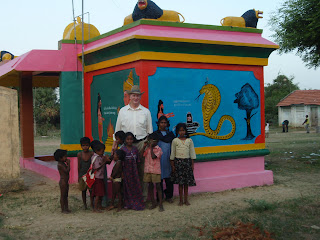
The village Hindu temple is sporting a new coat of paint; we endured several nights of blaring music as they celebrated some festival or other. The Hindu deity Ganesh is very popular in these parts--he is the elephant-headed son of Shiva, the elephant head motif indicating his ability to bestow great blessings. He is aided in all things by the sacred cobra, of course.
Our little chums wanted to show us where they live and have their photo taken again. This family is better off than many, having a plastered brick home with electricity.

Our return home reminded us that our little bungalow is really more than adequate in these parts. It certainly seems roomy to us now, and I am reminded of something Matthew said the day after returning from his two-year mission to Madagascar: "Why is our house so big? Why do we live in such a big home?" By the way, the sand is much easier to care for than a lawn, and doesn't require near as much water.

We hope all of you are doing well. Please leave us a comment. We would love to hear your thoughts.


